Showing posts with label extinction. Show all posts

Thursday, 14 May 2015

HEDGEHOG


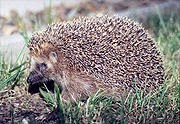
Despite its formidable spines we all love the hedgehog. Although most of us don't see any of them, we still adore them. Apparently, they managed to survive 16 million years and now have to deal with man and their numbers dwindle rapidly.
The common hedgehog has more than 5000 spines which are sharp, brown and cream coloured 1in (20-30 mm) long.
In the family of Erinaceidae are a dozen of species and five related moonrats. They are only in Europe, Asia and Africa. All hedgehogs become dormant when food is scarce. Hedgehogs do hibernate in Europe but not in the tropics.
After hedgehog's hibernation in the winter, they have their mating season in April. This mating could be tricky for the male but the female lowers her spikes at the back. Three to five young are born in early summer in a leafy nest. When the babies are born they are blind and the quills are under their skin like pimples. Soon their prickles break through the skin. This Mother Nature has it well arrange to protect the hedgehog mother during the birth.
When the hedgehog feels threatened it curls up in a ball and the spines coming out. The more it feels threatened the tighter it curls and the more the prickles stand up. It stays like that until it feels the danger it over. That is also the reason for many hedgehogs to end up dead on the road because they don't run. Some species are not passive and ram their spikes into a snout which comes to close.
Their long legs and claws help them to climb walls. If they do fall they use their spikes as a cushion. It is assumed that they are also used to float since they are hollow with air trapped inside.
Hedgehogs are mostly active at night. Their diet is beetles, caterpillars, earthworms, slugs, carrion and occasionally bird’s eggs. They are great pest controllers and eat about 200 gr a night. Unfortunately, you can't make them stay in your garden because they are great wanderers.
They can be quite vocal and grunt, snuffle and even sometimes squeal loudly.
Their live span is about 4 - 7 years.
They share diseases with Human being such as cancer, fatty liver disease and cardiovascular.
Hedgehogs were eaten in Egypt up till and including the Middle Ages. Some folk remedies included them as an ingredient.
One sad news, experts stated that hedgehogs are in danger of extinction. According to the statistics 50 year ago there were 36 million hedgehogs but today it is estimated there are only one million. Wow this is really a record, humans can not be proud off.  It is also feared that in Britain soon there will be extinct.
One advice the expert can give is not to feed them with bread and milk because it upsets their stomach. It is better to feed them with dog or cat food or better still to crush unsalted peanuts, shelled sunflowers seed and meal worms. To put down a shallow dish of water and not a deep one in which they could drown. Also provide a corner behind the garage or shed with wild brambles and leave a pile of leaves for them to take up residence. If you have to burn the leaves make sure you check there is not one in there. Otherwise just leave the pile of leaves.

Monday, 7 October 2013

ELEPHANTS IN DANGER OF EXTINCTION-- Updated 22 May, 2017


Update 22 May, 2017 --
Poachers have new tactic which is, unfortunately, more effective as well as more safe to be caught.

They poison the waterholes!

At the moment there are more elephants killed than born.

UPDATED: 10 June, 2015 -- Police caught two shipments totalling seven tonnes Ivory. They arrested three suspected top men of an suspected Ivory smuggling ring. It is also thought they finance terrorists.

Tycoon Abdurahman Mohammed Sheikh was arrested with his two sons at his mansions 


3.7 tonnes from Singapore was worth £40million and it was the second largest from Kenya since 2002. The other shipment was intercepted from Thailand which had 511 raw task and hidden in containers of tea. Both were destined for the Far East. Police Officer will investigate further and find more suspects. Daily Mirror revealed last year cartels are linked to  British terrorist Samantha Lewthwaite to finance attacks. The illegal Ivory trade is worth £4.5billion.


The ivory trade has raised its ugly head an again and the illegal killing increased last year – 2012.


In 1989 Kenya’s President Daniel Arap Moi set fired to 1`2 tonnes of confiscated elephant task, the value was hundreds of thousands of pounds at that time. Soon after CITES the Convention on International trade in Endangered Species of Wild Fauna and Flora made it law to ban trade in ivory. After this the demand went down drastically. It was hoped than the elephant population would increase.

For unknown reason the trade in ivory increased again a decade ago. Last year was the highest number, so far, of elephant being killed and their task removed. The biggest seizure so far was in Malaysia last month. They discovered 24 tonnes which are 1,500 tonnes, worth £12.4million and death of 750 elephants.

Between January and March in 2012 an incredible 50 per cent of elephant in Cameroon’s Bouba Ndjida National Park were slaughter by bandits.

March 22, 2012  -- 22 elephant corpses were found in Garamba National Park. They way they were positioned it was thought they grouped together to protect their young. All been shot from above and it looked that a helicopter was used.

October 2012 in Hong Kong a record of 3.81 tonnes of ivory was seized. It was the biggest haul in China. The 1,209 tusk and ivory pieces were on board of a ship coming from Tanzania.

October  31, 2012 in Tanzania was 200 tusks were discovered.

The conservationist Jan Goodall suggest that the demand in the last decade had rising because of a number of people getting very rich especially in China.  Tom Milliken director of TRAFFIC which is the wildlife trade monitoring network explains ivory has raised substantial in price over the last decade. In China it is even a status symbol to use chopstick mad from ivory. By now it is the sterling silver of the Far East.  He explains further that China still has that status obsession which is a link to the imperial past.

The other markets are the tourist markets in Thailand which are full of trinket and ornamental carving made from ivory. People still buying it and even the young ones. They know it is ivory but will they know it is from poaching elephants?

Also the West has its impacting demand.  Since travelling is so available the Western tourists are buying these goods and bringing them back as gift and souvenirs. There are enough bangles, beads and brooches to make you look beautiful it does not have to ivory.


Apparently the Chinese government became very alert to illegal ivory trade and made two ivory seizures a day scanning ship containers. Also the luggage and bags are being searched which are brought back by Chinese nationals.

All these successes don’t seem to deter the poachers and trade. Mr Milliken points out that it is the country which don’t report a seizure are heavily involved in the illegal trade such as Thailand, Nigeria and Cameroon.

Ms Goodall thinks that education could have a great impact and she explains that some people who bring ivory over the border don’t even know that it is illegal. Therefore, a good campaign would make an impact.
Chinese basketball star Yao Ming who is the equivalent of David Beckham had joint the fight. It will influence the illegal trade greatly. He made a film standing next to dead rhinos and elephants to show the people what happens in other country. It will be a powerful message being such a well know star. Also Jackie Chan is getting involved and tried to send out a powerful message.

Mr Milliken stated further that in the eighties Japan had half of the illegal trade and today it is only one per cent. This proves that a powerful campaign can turn things around.

Ms Goodall also contacted David Attenborough to ADD his name and influence to the campaign. She said that it not only the animals get killed, it is also Park Rangers.  In the Tsavo National Park in Kenya there were 12 park Rangers killed and 60 poachers over six year. Yet, they still do it. 

The problem is that when a Park Ranger is killed the family automatically loses their homes and the children can’t go to school any more which is totally unfair because the Park Ranger gave his life. She also campaigns for more contribution to pay the Park Rangers and their families especially when the ranger is killed.


ELEPHANTS BEMOAN THEIR DEAD. MOTHER HAD BEEN KILLED AND THE VERY YOUNG BABY TOUCHING HER HOPING SHE WILL WAKE UP AGAIN.  IS IT NOT A VERY SAD PICTURE?  IT SHOULD PUT THE HUMANS TO SHAME  --  BUT WILL IT?

LIONS POPULATION DECLINING


What would Africa be without their lions? Yet they get hunted and/or pressured all the time into smaller spaces. A great warning signal came from Dr Luke Hunter, president of Panthera which is a leading organisation of wild cat conservation.

He stated that it is wrongly to assume the lions are doing well. Apparently only in the last few year the decline had sped up enormously and it is slowly heading towards extinction. It is not even a century ago when there were 200,000 lions living in Africa. This number has dropped alarmingly and unbelievable down to a mere 30,000. A further revelation tells us that 200 years ago, before Europe started to have colonies in Africa; the lions existed everywhere in Africa except in the Sahara, the Congo and the rainforest. It is estimated that there were millions.

=================================================
PLEASE BE SO KIND AND CLICK ON ADVERTS.  THANK YOU
=================================================

Since 2002 lions became already extinct in five countries. Today there are to be found in only 28 African countries and one Asian country – India.  However, there are only seven countries which have at least 1,000 left in Botswana, Ethiopia, Kenya, South Africa, Tanzania, Zambia and Zimbabwe.


LIONS  IN THE SAVANNAH

The greatest problem is the disappearance of the lions’ habitat. The best example, the Africa savannah disappeared over the last 50 years. The savannah grassland used to be the homeland for lions but has now been broken up into farmlands or developments. A study revealed that the lions’ population is on the verge of extinction especially in West and Central Africa.

Africa has the fastest growing human population than any other continent and this alone has a greatest impact on wildlife including the lions. Since human habitat spreads into lions’ territory it multiplies the danger of attack.  The result is herder either spears, shot or poison them.  In Kenya alone 100 lions are being killed every year.  The country has a lions’ population of 2,000 and with a loss of 100 a year does not give a great survival rate.

Dr Hunter is fully aware to the problem of lions’ attacks either to the livestock or the farmers and herders themselves.  The lions will also increase their attacks since their own prey such as antelope are being over-hunted by humans. Dr Hunter came to the conclusion there could be an answer to save both the humans and lions.  The established conservation in good game reserves and national park has shown a great increase of lions. A fine example is South Africa the National Kruger Park is the size of Israel. Another one is Tanzania is still wild and has mostly large protected areas.


The other way of life for humans and lions to live side by side Dr Hunter refers back to centuries ago. The Masai Tribe had been herding their cattle, which is their main asset, for century across the savannah’s grassland.  They were also known for traditional lions hunt but infrequent. Today it has increased a great deal and as before it was no problem to have a hunting party now and then tradition is forgotten and they kill lions because they attack their cattle. This change of outlook causes now a great damage.

The answer to this is a programme to change lions’ hunter into lions' guardians.  This brings back the old method of good protection of their livestock which avoids problems with lions.  The basic rules are the lions can’t get to the livestock and fewer lions get killed.

One great danger of lions being killed by poachers is either for bush meat, for trophies and for Asian's traditional medicine trade.  Unfortunately, every part of a lion had a potentially use in Asian medicine.  There is also an increase because of the demand.


Dr Hunter states that if there isn’t a drastic change it only would take a couple of decades and lions will be found only in very isolated places like the tigers today.

A rare northern white rhino is already being guarded with a soldier equipped with a rifle on each side while it is grazing. This is a disgrace to humans with their endless greed.


IS THAT WHAT WE WANT FOR EVERY LAST ANIMAL?

EVEN GREED SHOULD NOT OVERRULE COMMON SENSE

Tuesday, 31 July 2012

CHEETAH Update 27 Dec., 2016

A new report revealed that the Cheetah heading with great speed for extinction. One reason is the babies are worth £10,000 on the black market in the Middle East even so 85 per cent die in transport, The other reason is their great speed needs a greater space and they often run further than the protected areas and come in conflict with poachers, farmers and hunters.

CHEETAH
Cheetah differs a great deal from the rest of the family Felidae.  Great number of characteristic is more like being part of the dog family – long legs, hard, padded paws and with non-retractable claws.

The cheetah is known as the fastest land animal and it can go up to 112km/h (70mph). Its slender body is more like a greyhound and the back is very light and flexible, therefore producing long strides and accelerates rapidly. The cheetah’s claws do not sheathed when retracted which gives an extra grip on the ground when at high speed.

The cheetah is mostly filmed at the Serengeti Plain, in Tanzania. It is an open area and therefore they can be easily tracked down and filmed. They also live in wetter savanna, woodlands, hills or mountainous areas. One place they will not enter iss the rainforest.

DIET

The cheetah hunts alongside other predators like lions, leopards, hyenas, wild dogs and jackals. However, with it s high speed it will hunt springbok, gazelles and antelopes and therefore has less competition.  In wetter savanna it hunts impala, kob, lechwe and reedbuck. Cheetahs hunt late in the morning while other predators are still sleeping.

Besides their enormous speed they also run for about 300 m before they run out of breath and their body is overheated. It does stealth and creep with 50 yards, like a cat, and starts the chase. Cheetahs can overtake gazelles and kill it. Antelopes have the ability of turning sharply and if it manages it several times the cheetah runs out of breath and the antelope wins.

HABITATS

The cheetah spreads widely over a large area of Africa. However, they too are under threat of extinction because of the spreading of agriculture. It is though that at the moment they are about 14,000 animals. Although it sounds a lot but it is half the number from the 1950s.  The pressure will still increase the more crops is raised.

HISTORY

Cheetahs evolved in southern Asia but not many survive. It spread once across the Middle East.  When it was hunted for its fur it only left a few of the Asian subspecies.  Scientists discovered that the DNA of today’s cheetahs was so similar that they think it must have been wiped out at its history. They also assume that it recuperated its number from one female. This creates a problem for a low resistance to diseases. It could one day be a case of being wiped out because of it.

TERRITORY

Their hunting can cross to other territories and several males could end up in the same territory of the same female. The female urinates on certain bushes, rocks or tree trunks. Even with several males in the same area they do have their rules. It is only the dominant male which mates with her. The others wait close by. The pair mates several times over the next few days. The moment their time of mating is over they separate.

BIRTH

After less than three months the female gives birth. She is by herself and brings the cups up alone. They normally have about three but it has been know they had one and up to eight cubs. When they are born they are covered by blue-grey hairs but on the top of their bodies. They are 30cm long and weigh about 250-300g. The nest is well hidden in deep grass and deep in a shelter of dense bushes. The mother still moves them every few days to a new place. The reason is to prevent a built-up of strong odour and therefore attract predators. In spite of all this precaution half of the cups get still killed during the first three months.

After five or six weeks they accompany their mother and share the kill but they still suckle till they are three months old. They stay with their mother till they are between 13 and 20 months. During this time they how to hunt.  Eventually the mother leaves but the cups stay together to hunt for several months more. Then the females move away one by one and find their own territory and live there their solitary live. The brothers stay together, sometime forever.